
The IDIA Hub · Identity Verification Utility
Trust Infrastructure Utility
The Trust Infrastructure Utility is IDIA's outgoing identity-reference and consent-validation engine for enterprise buyers and AdTech integrations. Members give their IDIA Key directly to a business when it asks for cookies or data sharing, so the batch the business sends already names each member by IDIA Key. The utility checks each IDIA Key against that member's consent, returns authorized or denied results without exposing the key, charges authorized matches in Synapse Credits and records transaction references. It checks the basis for an access request; unlike The Vulture, it does not ingest or sanitize a sensor stream.
Production operation has not been independently verified. Identity resolution and transaction provenance do not certify source accuracy, anonymity, security or lawful downstream use.
Real screenshotThe IDIA Hub
The IDIA Marketplace · Trust Infrastructure Utility
Credit balance and pending verification activity are from a team account.
What the Utility Does
Identity, Consent and an Accountable Transaction.
- 01
The IDIA Key
Every Life by IDIA member has an IDIA Key. When a business asks for cookies or data sharing, the member can give the business their IDIA Key, so the batch the business sends already names the member by IDIA Key and no email, phone number or other personal detail is needed. IDIA does not keep a lookup table of members' emails or phone numbers. The older hashed-target lookup is not connected to Life by IDIA, so hashed targets are denied unless they resolve. The protocol response keeps the key internal (the guid field is null). A key does not establish every legal requirement for a campaign.
- 02
Identifier-minimizing ledger
The batch intake stages IDIA Keys and accounting fields rather than raw identifiers. Protocol validation uses SHA-256 target hashes. Hashes and IDIA Keys can still be linkable; the reviewed code does not establish universal anonymity or secure memory erasure.
- 03
Consent-related authorization
Unresolved targets and explicit consent=false responses are denied, with no liability_receipt_id. An IDIA Key is authorized unless the member's consent record explicitly returns consent=false. This is not a strict default-deny check of every Life consent scope and does not prove compliance with municipal privacy law. Batch intake instead stages matches as pending_consent.
- 04
Two accounting paths
Protocol validation charges authorized matches immediately and idempotently. Batch intake stages debt first; settlement bills only consented or unpaid rows with an ACA hash, leaving rows without an ACA unbilled. The contributor share is 30% in the wider settlement model, not evidence of an instant payout for each validation response.
- 05
Ledger receipts and on-chain evidence
Authorized validation results carry an extraction-record ID as liability_receipt_id; denied results carry null. The extraction ID is a ledger reference, not proof that the Liability Receipt NFT has been minted. Receipt history separates ledger_recorded from anchored_l2; an ACA hash and actual blockchain evidence must be checked separately.
- 06
Per-organization activation
C-suite controls utility_provisioned and utility_rate for each business. API credentials must be active Identity Verification keys; a key alone does not activate service access.
Verification Lifecycle
From a Request to Traceable Evidence.
Two distinct paths share these stages; intake does not imply immediate authorization or minting.
- 1
Authenticate
An active utility key identifies the caller; organization provisioning is checked.
- 2
Receive
The business sends the IDIA Keys its members gave it; no email, phone number or other personal detail is needed.
- 3
Minimize
Intake ledger entries retain IDIA Keys and accounting fields, not the raw identifier.
- 4
Authorize
Protocol follows the member's consent record; intake waits for consent and an ACA mandate.
- 5
Account
Protocol charges matches now; intake settles eligible staged debt later.
- 6
Trace
Read the receipt and its status; on-chain anchoring is a separate state, not automatic proof of minting.
Synapse Credit Metering
A Rate Per Authorized Match.
The reviewed default is 2.50 Synapse Credits per authorized protocol target or matched intake record. Each organization can have a negotiated utility_rate; the active rate card, not this default, governs. At the default, 10 authorized matches cost 25 CR; denied protocol targets are not charged.
Staged Intake and Settlement
Batch intake accepts records, identifiers or the legacy infractions array (up to 1,000 records) and writes pending_consent rows. settle-utility-balance requires a signed-in user's bearer token, selects consented/unpaid rows with ACA hashes, checks credits and forwards the exact staged amount to Synapse Controller. Missing ACA rows remain unbilled. INSUFFICIENT_CREDITS is a response-body error on this settlement path, not necessarily HTTP 402.
POST https://zxyngqciipcvveigrzqt.supabase.co/functions/v1/identity-verification-intake
POST https://zxyngqciipcvveigrzqt.supabase.co/functions/v1/settle-utility-balance
Developer Integration
Validate Hashed Targets.
Use an active Identity Verification key and a unique Idempotency-Key. Replace the example hash with 64 hexadecimal SHA-256 characters (no 0x prefix). These examples use sandbox: payload validation still applies, but every target is denied, nothing is charged or stored, and no receipt is issued. Keep credentials on your server.
curl 'https://zxyngqciipcvveigrzqt.supabase.co/functions/v1/protocol-api/v1/utility/validate' \
+  -H 'Content-Type: application/json' \
+  -H 'x-api-key: YOUR_IDENTITY_VERIFICATION_KEY' \
+  -H 'Idempotency-Key: YOUR_UNIQUE_REQUEST_ID' \
+  -H 'X-IDIA-Environment: sandbox' \
+ --data '{"target_type":"hashed_email","hash_algorithm":"sha256","targets":["YOUR_64_CHARACTER_SHA256_HEX_HASH"]}'| Status | Meaning |
|---|---|
| 400 | Invalid target type/hash/payload, or missing Idempotency-Key on protocol validation. |
| 401 | Missing, invalid or revoked utility key; settlement requires a valid user session. |
| 402 | Protocol validation: insufficient Synapse Credits (insufficient_funds). |
| 403 | Utility not provisioned; batch intake also rejects a mismatched extractor_id. |
| 413 | More than 1,000 targets or intake records (batch_too_large on protocol validation). |
| 429 / 500 | Protocol rate limit exceeded (120 requests per key per fixed minute), or an internal/billing failure. |
Evidence and Buyer Coverage
A Receipt Is Not a Blanket Guarantee.
The Liability Shield is conditional buyer coverage; its actual token is the Liability Receipt NFT. Coverage concerns consent/identity claims and traceable IDIA-data breach claims, subject to the buyer agreement. The company-stated $0.25 per consumed credit comes from IDIA's 60% share; coverage is capped by the buyer's estimated contributions. It is not insurance or legal advice, and buyers remain responsible for their own use.
Production operation has not been independently verified. Identity resolution and transaction provenance do not certify source accuracy, anonymity, security or lawful downstream use. Independent security assessment and documented threat-model review remain planned.
Two Engines, Distinct Responsibilities
Incoming Integrity. Outgoing Validation.
Two distinct boundaries, one accountable data lifecycle: The Vulture handles incoming data and its integrity trail; the Trust Infrastructure Utility handles outgoing target validation and access accounting. Neither engine makes data automatically lawful, anonymous or factually true.
The Vulture
Real screenshotThe IDIA Hub
Vulture · Mesh Node Integration
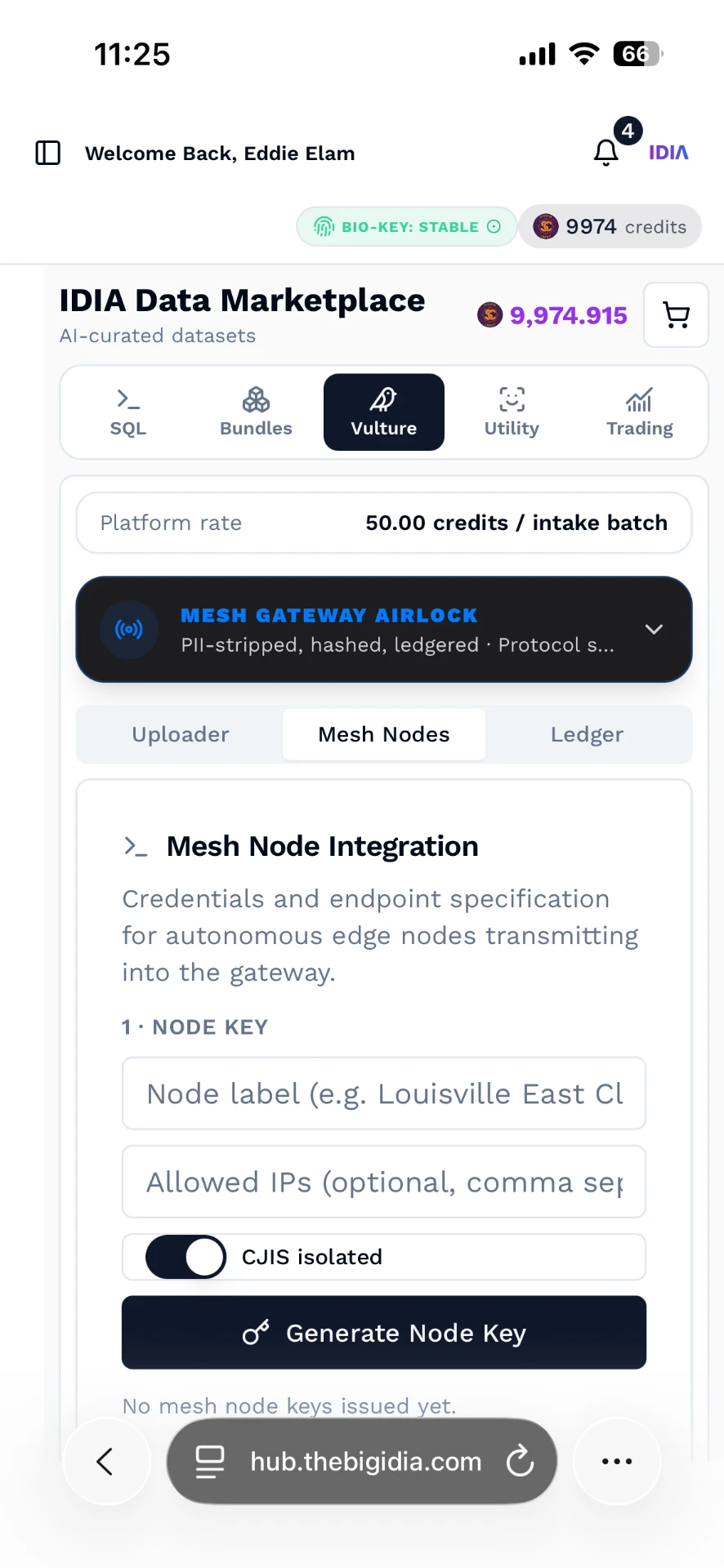
The Vulture tab in the Hub's Data Marketplace. The Mesh Gateway Airlock banner reads PII-stripped, hashed, ledgered. Partners label a node, optionally limit it to allowed IP addresses, generate a node key, then post to the ingest endpoint. Uploader and Ledger sit beside Mesh Nodes.
Credit balance shown is from a team account.
Trust Infrastructure Utility
Real screenshotThe IDIA Hub
The IDIA Marketplace · Trust Infrastructure Utility
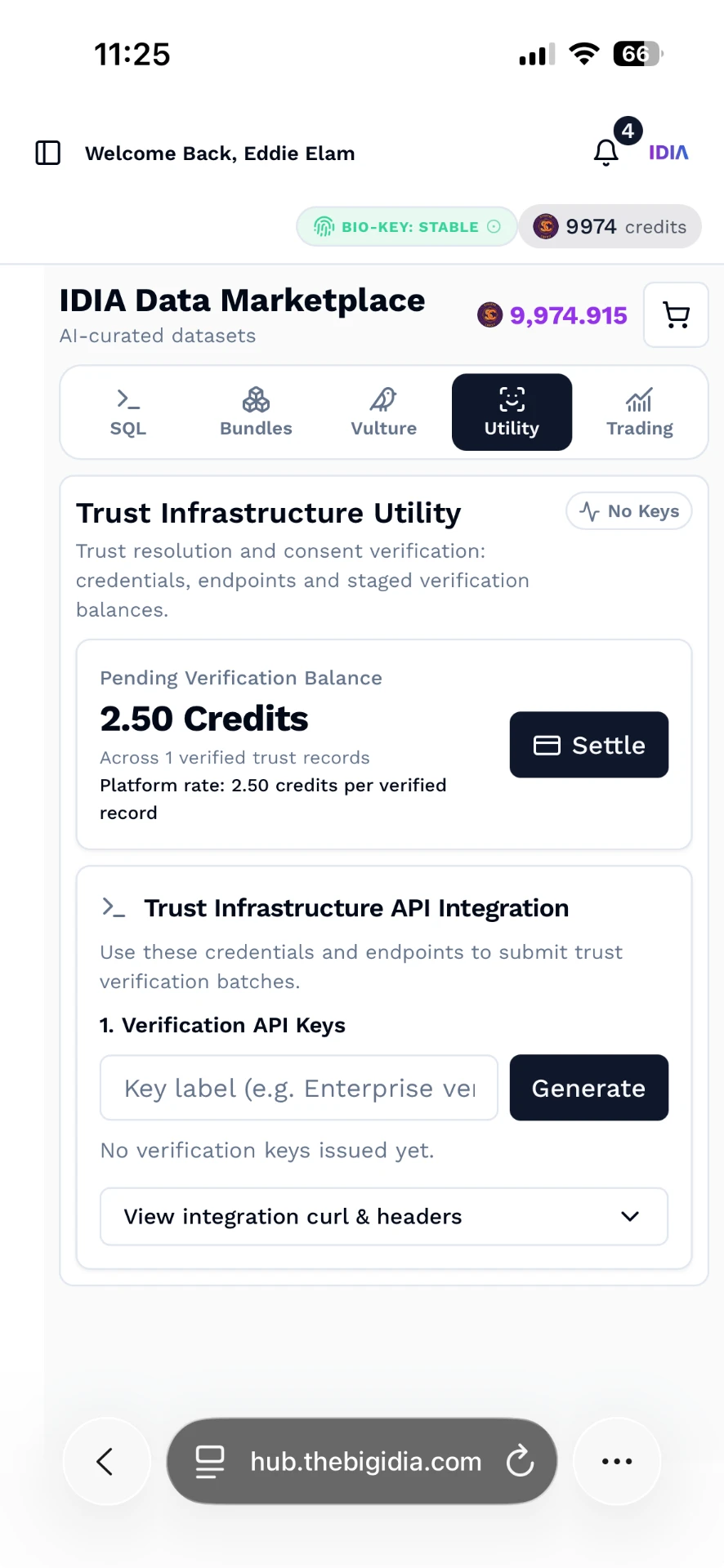
The Utility tab shows a pending verification balance, a Settle control, verification API key creation and integration headers. Pending verification is not completed settlement or a confirmed on-chain NFT.
Credit balance and pending verification activity are from a team account.
- Direction
The Vulture
Incoming telemetry, node events and enterprise uploads.
Trust Infrastructure Utility
Outgoing access requests represented by hashed IP, email or device targets.
- Primary Work
The Vulture
Sanitize recognized fields, quarantine problematic inputs and stage content hashes.
Trust Infrastructure Utility
Resolve identity references, check each IDIA Key against the member's consent and account for authorized matches.
- Evidence
The Vulture
Sanitized hashes, Merkle inclusion proofs and Base anchor details when available.
Trust Infrastructure Utility
Authorization decisions and extraction-ledger receipt IDs; NFT minting requires separate evidence.
- Control Boundary
The Vulture
Does not establish source truth, total PII removal or court admissibility.
Trust Infrastructure Utility
Does not independently check every consent scope or guarantee legal permission to target a person.
Shared Access, Distinct Billing Paths
Both services require organization activation and service-appropriate credentials. They use Synapse Credits, but charges and failure handling vary by path: protocol validation and mesh intake can return HTTP 402; staged Utility settlement can instead report INSUFFICIENT_CREDITS in the response body. A staged record is not a completed licence or payout.
Ingest to License: The Intended Lifecycle
In an intended municipal or enterprise deployment, sensors send telemetry through The Vulture; sanitized records and hashes are staged, then notarized. Separately, a buyer can submit target hashes to the Trust Utility and inspect access decisions and receipt status. This is a design-level lifecycle, not evidence that every Vulture record is automatically licensed, paid out or minted through the Utility.
Integrate the Trust Utility
Confirm Access, Consent and Responsibilities.
Enterprises and developers
Request utility access
Discuss organization activation, Identity Verification keys, expected volume and the applicable credit rate.
Request utility accessIntegration teams
Review integration requirements
Confirm identifier types, consent workflow, receipt evidence and data-handling responsibilities before sending any real identifiers.
Review integration requirementsGovernment and institutional buyers
Request a Security Addendum
Review security, privacy and contractual coverage requirements with IDIA. Independent assessment remains planned.
Request a Security Addendum