
Data Integrity & Deletion
Proving where data came from is not the same as proving it is safe.
Our consent records and receipts show who agreed to share what, and when. They do not certify that data is accurate, anonymous or secure. This page sets out the difference, what is still unverified, and exactly what happens when you revoke consent or delete your account.
Provenance vs certification
What our records prove, and what they don't
Proves
- Who gave consent, for which data stream, and when (consent hash written at opt-in).
- That a record has not been changed since it was logged (tamper-evident, append-only ledger).
- Which consent records sat behind each sale (soulbound Liability Receipt NFT on Base).
- Where each royalty payment went (on-chain transfers anyone can look up).
Does not prove
- That the underlying data is accurate or truthful. A device or a person can still report wrong values.
- That de-identified data can never be re-identified by someone combining it with other sources.
- That our systems are secure against every attack. No independent security assessment has been completed yet.
- That everything a buyer does with the data is lawful or fair. The Liability Shield covers consent, identity and breach claims under set conditions (see below); the rest of a buyer's use is their own responsibility.
Why buyers ask for this
Under the GDPR, personal data may only be collected for specified, explicit purposes (EU General Data Protection Regulation, 2016), so a buyer has to be able to show what each record was shared for. And 87% of consumers surveyed said they would not do business with a company if they had concerns about its security practices. (McKinsey & Company, April 2020) Provenance records answer the first need. They are not a substitute for the security reviews listed below.
What a Verified Truth means
A Verified Truth proves where data came from, who consented and that it was bought. It does not certify that the data itself is accurate, anonymous or safe for every use. Purge Identity stops new Verified Truths being made from your data; ones already recorded stay on Base.
Liability Shield & Indemnity Reserve
What we cover for data buyers, and what they must do
Provenance alone doesn't protect a buyer. The Liability Shield is IDIA's promise to cover buyers for consent, identity and breach claims tied to our data, backed by money set aside in IDIA Indemnity Reserve LLC. Its token is the Liability Receipt NFT on Base. It only applies when the buyer keeps up their side.
One shield, one token. The Liability Shield is the coverage. The Liability Receipt NFT is the token inside it: a soulbound NFT on Base, minted for each use, that records the consent records behind that use. The X-IDIA-LIABILITY-TOKEN header on delivered data carries its ID.
Step 01
A buyer uses a Synapse Credit
For every credit used on The IDIA Hub, $0.25 from IDIA's 60% share is set aside in IDIA Indemnity Reserve LLC, a separate company whose money is kept apart from IDIA Data Inc.'s operating funds.
Step 02
The use gets a Liability Receipt NFT
A soulbound Liability Receipt NFT is minted on Base for the use. Egress Logs record its ID with the consent records behind each answer, and the same ID travels with the data in the X-IDIA-LIABILITY-TOKEN header.
Step 03
If a covered claim comes up
The Liability Receipt NFT shows exactly which consented records the data came from, and the reserve backs IDIA's promise to cover the claim, as long as the buyer met the conditions.
Covered
- Consent and identity claims. A regulator or a person claims that data a buyer got from IDIA was collected or shared without valid consent, or that it exposes who someone is.
- Data breaches traced to IDIA data. A buyer suffers a data breach, and data from IDIA is found in it and can be identified as IDIA's through its Liability Receipt NFT and consent records.
Buyer must
- Keep the Liability Receipt NFT ID (X-IDIA-LIABILITY-TOKEN header) and the consent record ID (aca_record_id) attached to the data. Stripping them ends coverage.
- Never try to re-identify anyone, or join IDIA records to your own customer data.
- Follow your Data Processing Agreement. Raw data also requires passing T-1-P vetting, including logs kept for at least a year and encrypted storage.
Not covered
- What a buyer decides or builds with the data, such as models, products or decisions about people, beyond the consent, identity and breach claims above.
- Use outside the licence, or after any condition above has been broken.
Where the $0.25 comes from
It comes out of IDIA Data Inc.'s 60% share of each sale, not the contributors' 30% or the DAO's 10%.
Coverage limit
Coverage is capped at what a buyer's own use has paid in: about $0.25 for each credit used, matching the Liability Receipt NFTs issued to them. It grows as they use more, and never exceeds that estimated amount.
Institutional buyers
Institutional buyers who pass T-1-P vetting get their own series LLC with a separate reserve account. The same rules apply: $0.25 per credit goes in, and coverage is capped at what that account holds from their use.
Liability Receipt NFTs on Base
Live now282 minted by October 21, 2026. Anyone can count them on Basescan.
IDIA Indemnity Reserve LLC
Live nowDelaware Certificate of Formation filed July 28, 2026.
$0.25 set aside per credit used
Live nowCompany-stated. Paid from IDIA Data Inc.'s 60% share of each sale.
This is a contractual promise from IDIA, backed by the reserve. It is not an insurance policy or legal advice. How to make a claim is set in each buyer's agreement.
Assurance status
Reviews done, and reviews still to come
Until the planned items below are complete and published, treat our security and privacy statements as company claims, not verified guarantees.
Independent security assessment
PlannedA third-party review of the apps, the Synapse Engine and the contracts. Not started; we will publish the scope and findings when it is done.
Documented threat model
PlannedA written list of who might attack the system, how, and what stops them. Planned; not yet published.
Raw-data buyer vetting (T-1-P)
Live nowCompany procedure for buyers of raw data: consent IDs stay attached, no re-identification, logs kept over a year, encrypted storage. A company check, not an independent audit.
In-app privacy controls
Live nowHardware permission switches, per-stream opt-in, consent-record CSV export and Purge Identity in Life by IDIA.
Deletion & Revocation
Delete your account; your rows are cleared within 30 days
Turn off a stream or a permission
Switch off a data source or a hardware permission (Device Motion, Camera, Health Kit) in Life by IDIA. From then on, no new data from it is collected or offered to buyers.
See and export your consent records
The Identity Ledger lists every consent record and lets you download it as a CSV.
Purge Identity
In Life by IDIA → Settings → Privacy → Purge Identity, Purge permanently deletes your account and keys. It triggers the Synapse Engine to clear every database row linked to your account's ID (GUID) within 30 days. After that, your data can no longer be found or sold.
What deletion cannot reach
- On-chain records on Base (receipts, consent hashes, payments) are permanent. They hold hashes and wallet addresses, not your raw data.
- Royalties already paid stay in the wallet they were sent to.
- Copies or derived works a buyer made before deletion — see below.
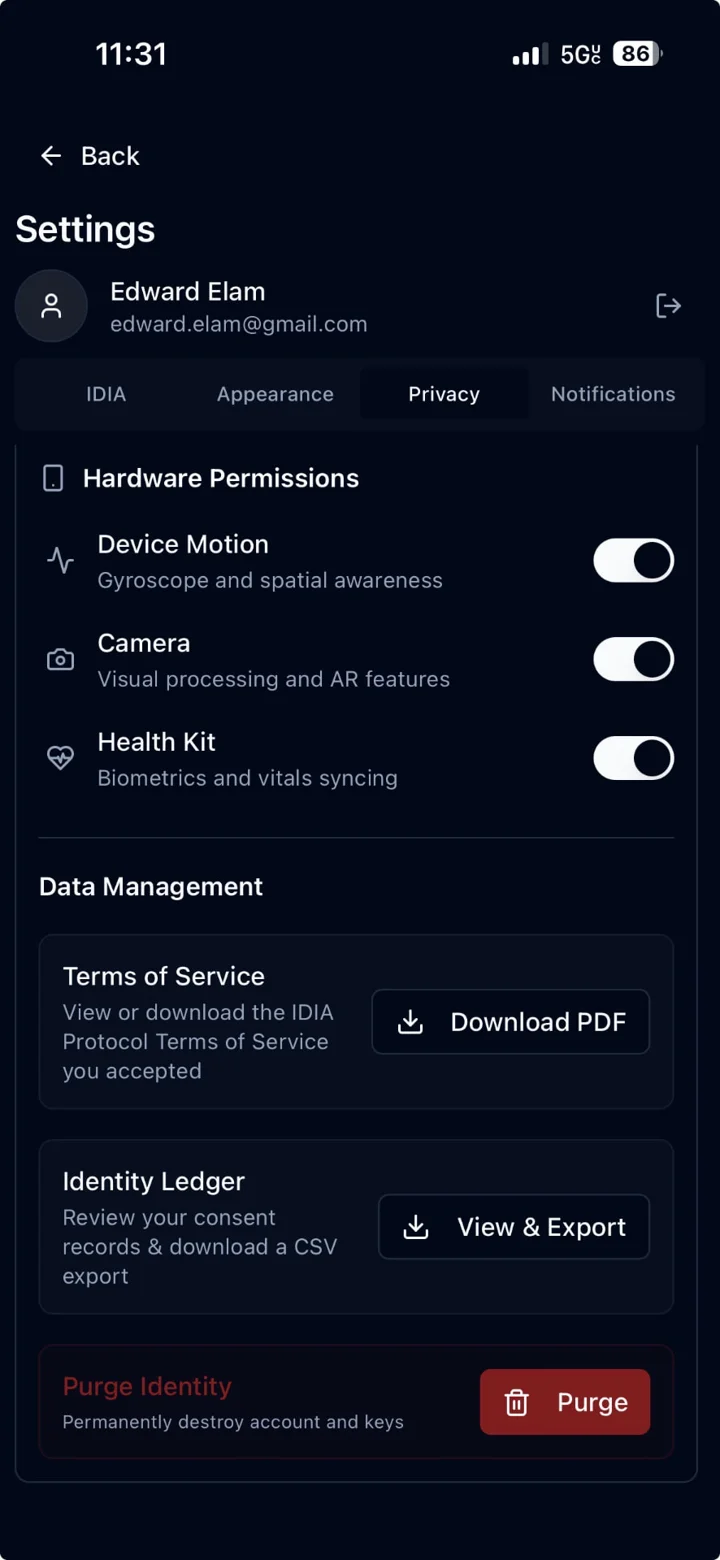
Real screenshotLife by IDIA
Settings · Privacy
Hardware permissions (Device Motion, Camera, Health Kit) switch on and off here. Data Management lets you download the Terms you accepted, view and export your consent records as a CSV, and Purge Identity to delete your account and keys.
Derived data
What an irrevocable licence means for derived data
When a buyer uses your data while your consent is active, they may turn it into something new: aggregate statistics, reports, or a trained AI model. This is derived data.
- Going forward, revocation is immediate. Once you switch off a stream or purge your account, no new queries include your data.
- Raw records are cleared. Your rows in our systems are deleted within 30 days of a purge.
- Past derived works are not undone. The licence for derived works created while your consent was active is irrevocable. A trained model cannot reliably "unlearn" one person, so we cannot recall or delete it, and buyers are not required to.
- No new royalties. Royalties come from new purchases, so none are paid on your data after you revoke or purge.
Before you connect a source, assume anything sold while it is connected may live on in derived form. The exact terms are in the Terms of Service you accept in the app; this summary does not replace them. See also the privacy policy.