
The IDIA Hub · Web app

Consented data streams, for your systems and your AI agents.

The IDIA Hub is the buyer side of the product journey. Organizations sign in, buy Synapse Credits, and use consented data streams through API endpoints, MCP connections and Best Friend AI. Every request is tied to the consent records behind it.

The IDIA Hub iconOpen The IDIA Hub Sign in with your Life by IDIA account, or with enterprise single sign-on.
The IDIA Hub — Opening screen. The splash screen shown when The IDIA Hub opens.

Real screenshotThe IDIA Hub

Opening screen

Three ways to use data streams

Plug in your code, your AI agent, or just ask.

Live now

API endpoints

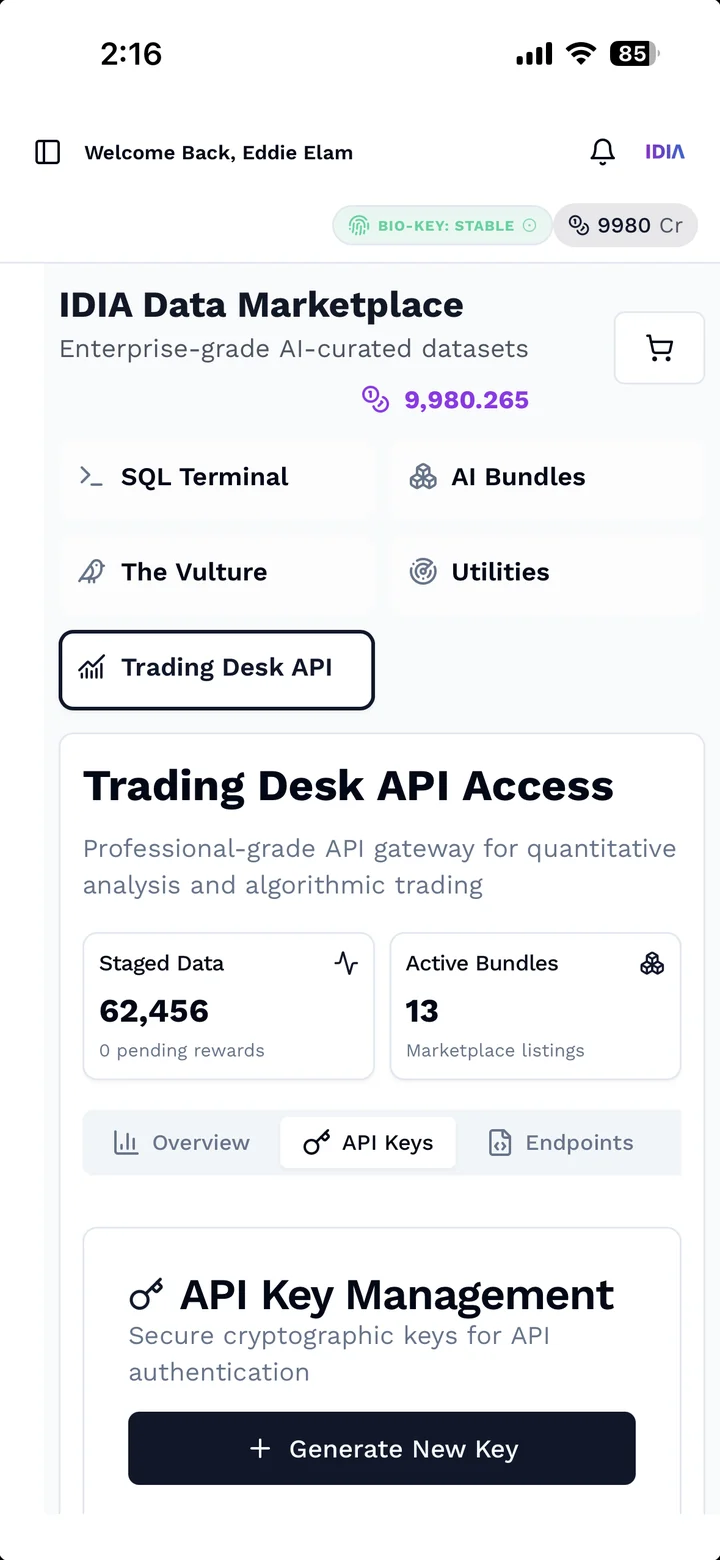
Trading Desk · API Keys and Endpoints

Buyers create API keys on the Trading Desk and call versioned endpoints (/api/v1/…) from their own systems, for Synapse data queries, Best Friend AI and the Sovereign Vault. Data queries use Synapse Credits and are written to the credit ledger.
Live now

MCP connections

Trading Desk · MCP Server Configurator

Buyers connect AI agents such as Claude Desktop, Ollama or Cursor over the Model Context Protocol. They choose which Hub tools the agent can see and download a ready-made mcp.json. Agent calls use the same credit and consent checks as any other request, and tools that move money need an extra signed check.

Live now

Best Friend AI

Throughout the Hub

Buyers ask in plain language what data fits their need. Totals are worked out on our server from the consented records, not guessed by the AI. In marketplace mode it looks across the marketplace; in personal mode it only sees your own data.

Raw data bundles

T-1-P Technical Vetting required

Raw data bundles are only released to buyers who pass our T-1-P Technical Vetting. A sales engineer checks the buyer's own systems: consent record IDs and Liability Receipt NFT IDs must stay attached to every row after the buyer's data cleaning, people cannot be re-identified, audit logs are kept for more than a year, and storage is encrypted. If any critical check fails, the contract stops until the buyer fixes it.

The T-1-P checklist is an internal company document. Partners can review it during due diligence.

Why buyers use The IDIA Hub

Small to start, priced per use, and a receipt for every query.

  • Start with $2

    Top up any amount from $2 at $0.75 a credit, or buy a volume tier down to $0.60. Credits are only used when you actually use data.

  • Pay per use

    Each request is priced on our server from the data's sector, your buyer weighting and how many records it uses. A Best Friend AI question is a flat 1 credit.

  • A receipt for every use

    Egress Logs record the credits charged, a DigiRAMP anchor, the consent records behind each answer and the ID of its Liability Receipt NFT, the soulbound token on Base: 282 by October 21, 2026, and anyone can count them.

  • Built for AI agents

    Connect Claude Desktop, Ollama or Cursor over MCP, choose which Hub tools the agent can see, and download a ready-made mcp.json.

Liability Receipt NFTs are evidence of the consent behind each use. Liability Shield coverage depends on conditions set in your agreement; it is not insurance or legal advice.

The market buyers are in

Companies spend tens of billions on data services, and they have to show consent.

Analysts put big data as a service at $55.8B to $70.3B today, growing fast. The figures below are theirs, with sources, and they do not agree with each other, so we show all of them.

Big data as a service, market size estimates

Today versus 2034, by analyst

Each analyst's own published figures. They define the market differently and IMARC's base year is 2025. Tap the buttons to compare one series at a time.

Data as a service, share of revenue in 2025

Who buys, and how it is delivered

21.47%Banking, financial services & insurance

Source: Mordor Intelligence, September 2026.

Forecast growth, % a year

The fastest-growing parts of the market

BDaaS = big data as a service; DaaS = data as a service. Healthcare and hybrid figures run to 2031 (Mordor Intelligence, September 2026); BDaaS figures run to 2034.

Why consent records matter

Trust decides who people do business with

87%

of consumers surveyed said they would not do business with a company if they had concerns about its security practices. (McKinsey & Company, April 2020)

  • Under the GDPR, personal data may only be collected for specified, explicit purposes (EU General Data Protection Regulation, 2016). A buyer needs to show what each record was shared for.
  • In The IDIA Hub, every use is written to Egress Logs with the consent records behind it and the ID of its Liability Receipt NFT.
See what the Liability Shield covers
Compare what your own project might cost the traditional way and on The IDIA Hub.Open the cost estimator

Indemnity Reserve & financial coverage

Buying data shouldn't mean buying someone else's consent risk.

Liability Shield · IDIA Indemnity Reserve LLC

Live now

Coverage for consent, identity and breach claims, backed by $0.25 from every credit.

Consent and identity claims

A regulator or a person claims that data a buyer got from IDIA was collected or shared without valid consent, or that it exposes who someone is.

Data breaches traced to IDIA data

A buyer suffers a data breach, and data from IDIA is found in it and can be identified as IDIA's through its Liability Receipt NFT and consent records.

How it is funded

$0.25 of every Synapse Credit used is set aside in IDIA Indemnity Reserve LLC, kept apart from IDIA Data Inc.'s operating funds (company-stated). It comes from IDIA's 60% share. Coverage is capped at what the buyer's own use has paid in. Each use gets its own Liability Receipt NFT on Base.

The Liability Receipt NFT is the token inside the Liability Shield. Coverage only applies if the buyer keeps its ID attached to the data and never re-identifies anyone. This is a contractual promise from IDIA, backed by the reserve. It is not an insurance policy or legal advice. How to make a claim is set in each buyer's agreement.

Full conditions and what is not covered

How a buyer buys data

From buying credits to the receipt for every query.

Four steps, each shown with real screens from The IDIA Hub. Each receipt is the Verified Truth you bought: data with its consent, its source and its on-chain record.

  1. Step 01 · Top Up Wallet

    Buy Synapse Credits

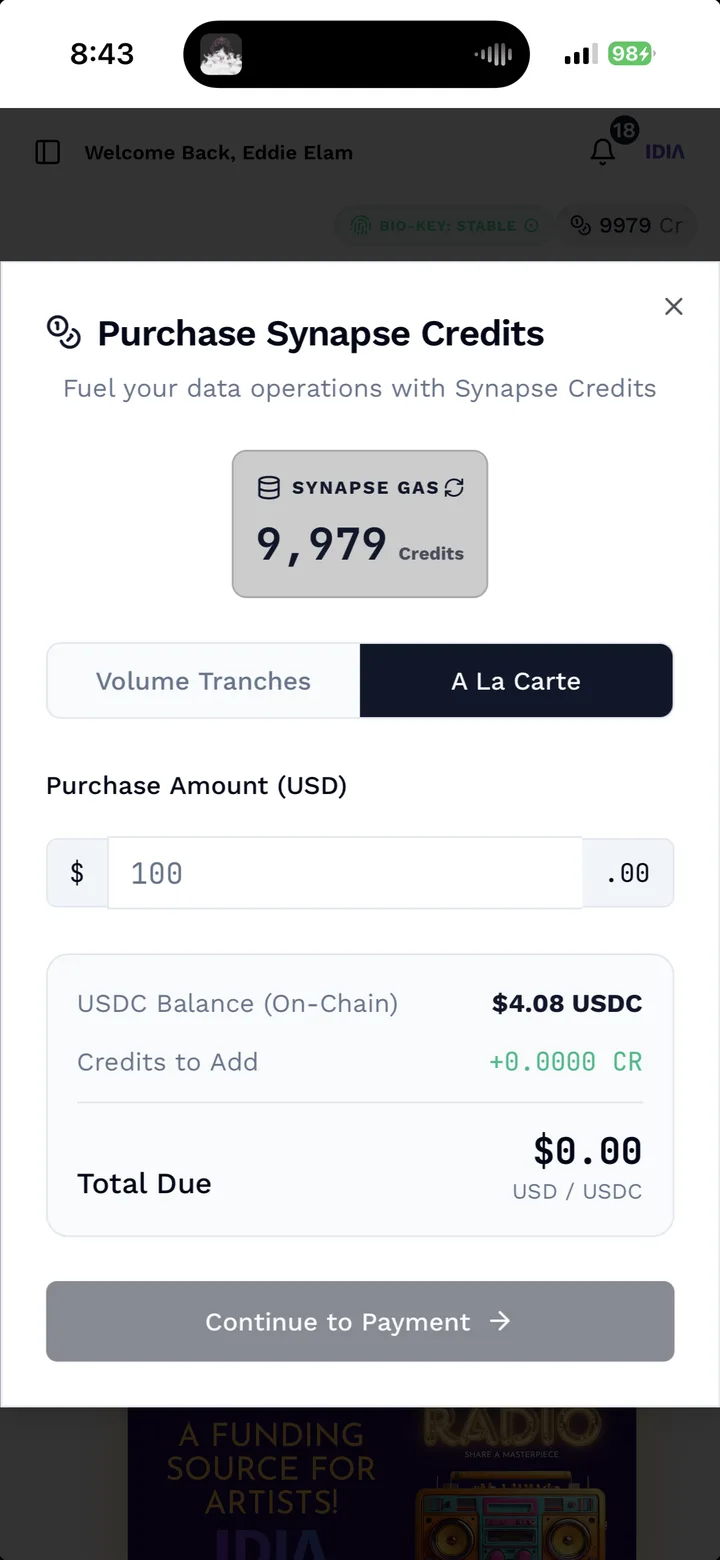
    Pick a volume tier — 1,000 credits at $0.70, 5,000 credits at $0.65, 20,000 credits at $0.60 — or pay any amount from $2 at $0.75 a credit. Pay in USD or from your USDC balance on Base. The credits go into your ledger.

    The IDIA Hub — Purchase Synapse Credits. Buyers top up Synapse Credits by volume tranche or à la carte, and pay in USDC or with their on-chain USDC balance.

    Real screenshotThe IDIA Hub

    Purchase Synapse Credits

    Buyers top up Synapse Credits by volume tranche or à la carte, and pay in USDC or with their on-chain USDC balance.

    Balances are from a team account.

  2. Step 02 · Trading Desk · Best Friend AI · Data Marketplace

    Choose how to use the data

    Call API endpoints from your own systems, connect an AI agent over MCP, or ask Best Friend AI in plain language. A Best Friend AI question costs a flat 1 credit. Other requests are priced on our server from the data's sector, your buyer weighting and how many records are used.

    The IDIA Hub — Data Marketplace · Trading Desk API. Synapse Credit balance, staged data and marketplace listings, with the API Keys and Endpoints tabs buyers use to connect their own systems.

    Real screenshotThe IDIA Hub

    Data Marketplace · Trading Desk API

    Synapse Credit balance, staged data and marketplace listings, with the API Keys and Endpoints tabs buyers use to connect their own systems.

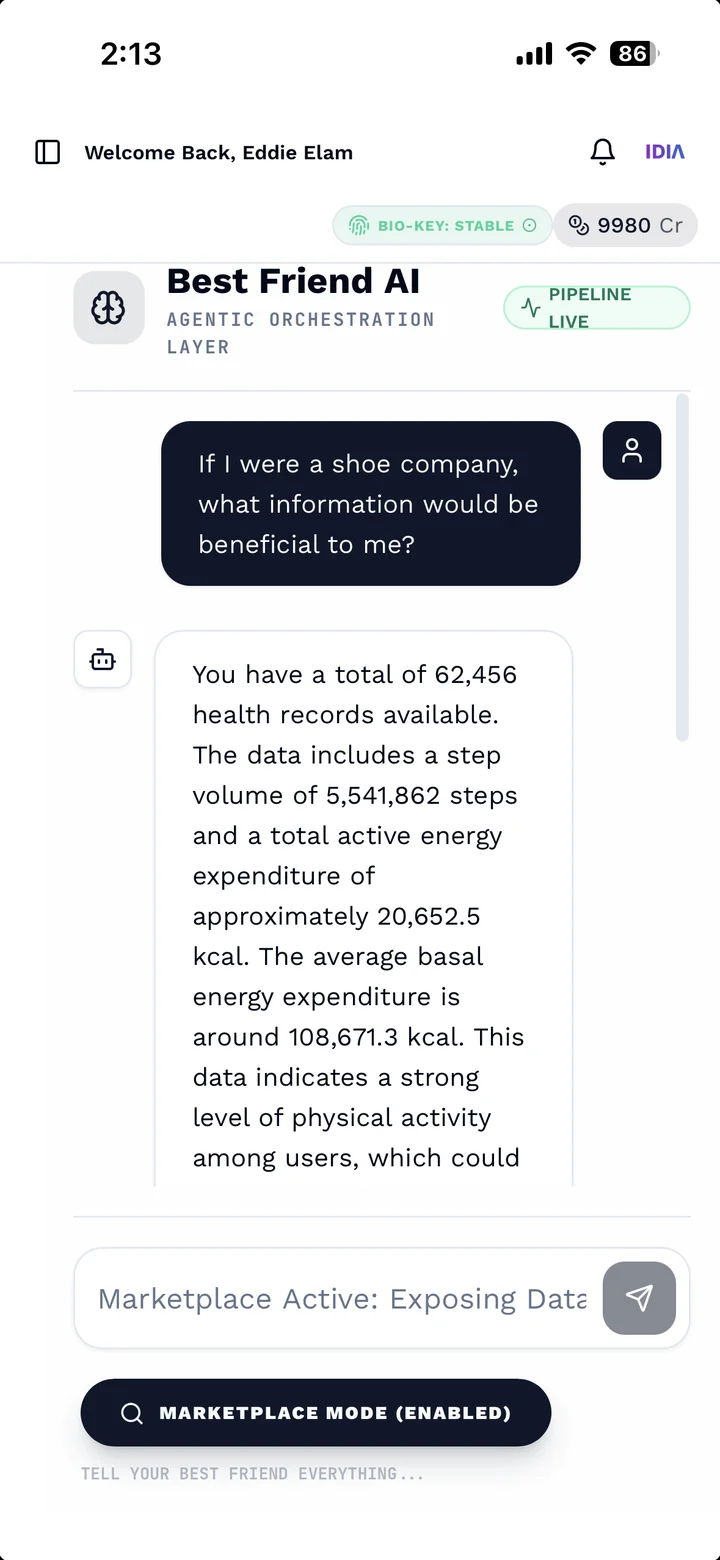
    The IDIA Hub — Best Friend AI · Marketplace mode. A buyer asks what data would help a shoe company. The assistant answers with totals across the available health records.

    Real screenshotThe IDIA Hub

    Best Friend AI · Marketplace mode

    A buyer asks what data would help a shoe company. The assistant answers with totals across the available health records.

  3. Step 03 · Egress Logs

    Data is used, and a receipt is written

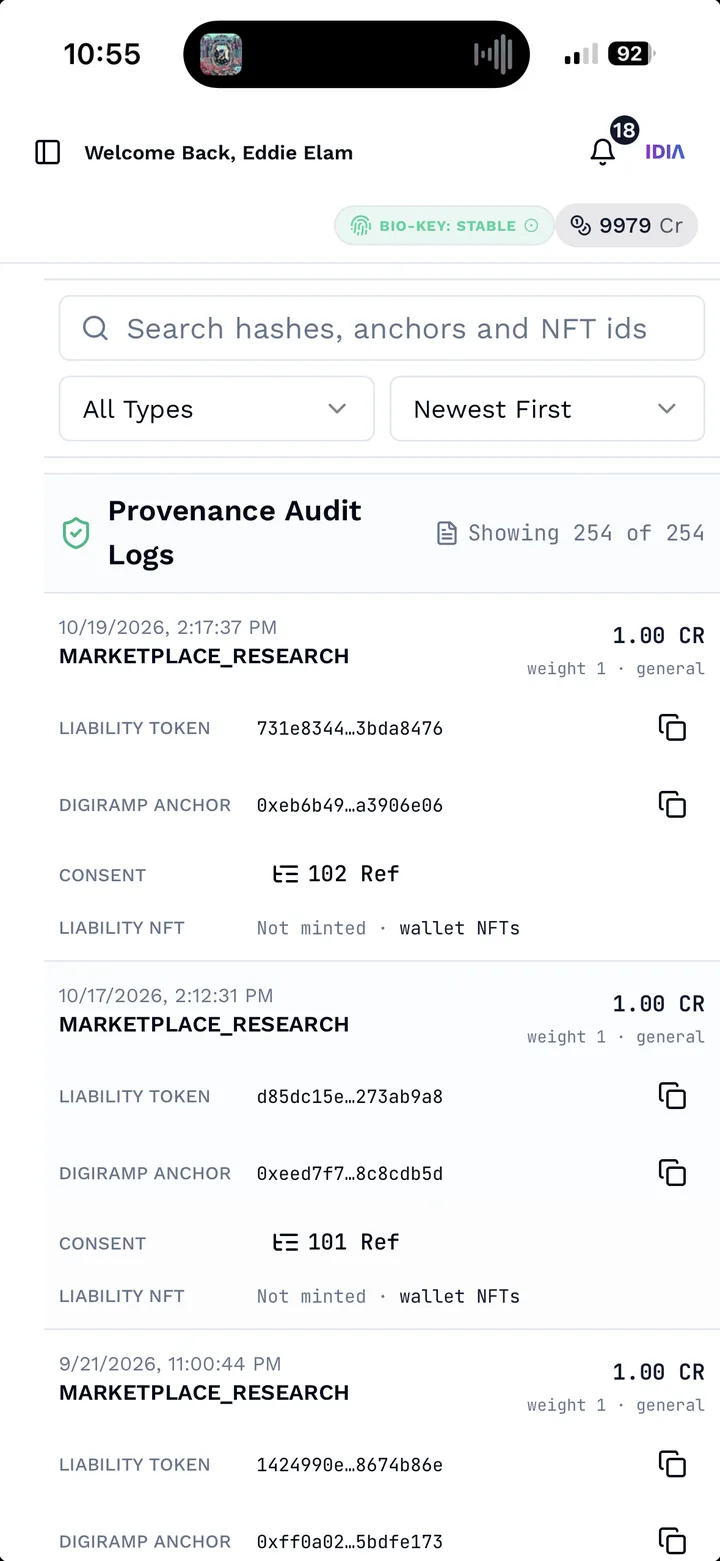
    Credits are taken off your balance and the use is written to Egress Logs: the credits charged and how they were priced, the ID of its Liability Receipt NFT and a DigiRAMP anchor. Under Consent, each receipt shows how many Auditable Consent Artifacts (ACAs) the answer drew on, for example "102 Ref". Tap it to page through those ACA hashes, copy them or download them. You can search receipts by hash, anchor or NFT id.

    What an Auditable Consent Artifact is
    The IDIA Hub — Egress Logs · Provenance Audit Logs. Every use of data leaves a receipt here. Each one shows when it happened, the type of use, the credits charged and how they were priced (weight 1 · general), the ID of its Liability Receipt NFT (the token issued under the Liability Shield), a DigiRAMP anchor and, under Consent, how many Auditable Consent Artifacts it drew on (102 Ref, 101 Ref). Receipts whose Liability Receipt NFT has been minted link to it on Base; these three show Not minted.

    Real screenshotThe IDIA Hub

    Egress Logs · Provenance Audit Logs

    Every use of data leaves a receipt here. Each one shows when it happened, the type of use, the credits charged and how they were priced (weight 1 · general), the ID of its Liability Receipt NFT (the token issued under the Liability Shield), a DigiRAMP anchor and, under Consent, how many Auditable Consent Artifacts it drew on (102 Ref, 101 Ref). Receipts whose Liability Receipt NFT has been minted link to it on Base; these three show Not minted.

    Balance and activity are from a team account testing the Hub.

  4. Step 04 · Saved Searches

    Look back at past queries

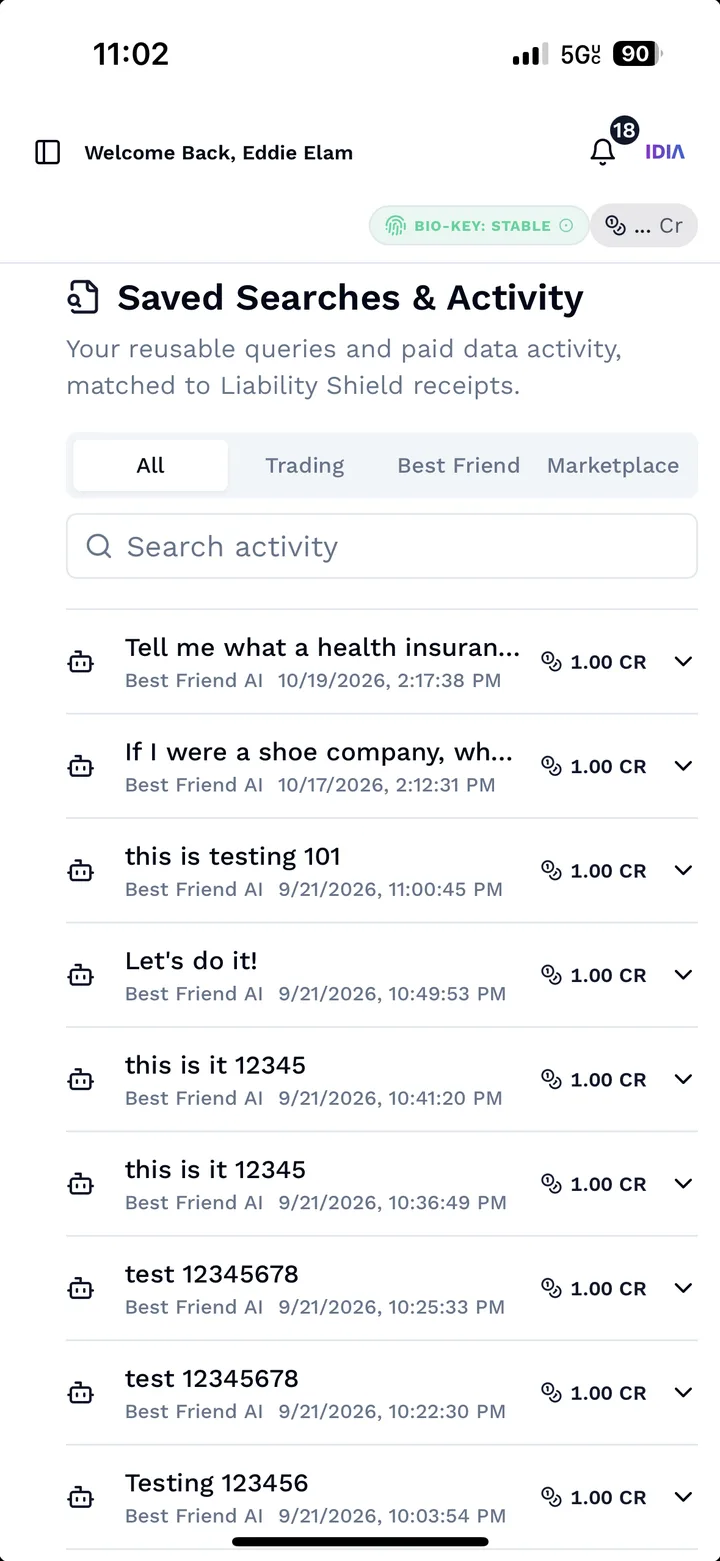
    Every past query from the Trading Desk, Best Friend AI and Marketplace is kept with what it cost and matched to its Liability Receipt NFT. Trading Desk queries can be saved and run again.

    The IDIA Hub — Saved Searches & Activity. Past queries, filtered by Trading Desk, Best Friend AI or Marketplace. Each row shows the question, where it was asked, when, and the credits it used. Opening a row shows the full question and answer, matched to its Liability Receipt NFT.

    Real screenshotThe IDIA Hub

    Saved Searches & Activity

    Past queries, filtered by Trading Desk, Best Friend AI or Marketplace. Each row shows the question, where it was asked, when, and the credits it used. Opening a row shows the full question and answer, matched to its Liability Receipt NFT.

    Queries are from a team account testing the Hub.

Live now

No matching consent fingerprint, no data.

An Auditable Consent Artifact (ACA) is a digital fingerprint that IDIA creates every time you take a consent action. It records that the action happened, from your account and your device, and when. Each one is a unique code called the ACA hash.

How the Hub uses them

  1. 1

    The request names its ACAs

    Every request for data says which ACAs sit behind the records it wants to use.

  2. 2

    The Synapse Engine checks them

    Before any data leaves, each ACA is looked up and matched to data held in IDIA's vaults. If none match, the request is refused.

  3. 3

    Matched ACAs go on the receipt

    Only the ACAs that check out are written to the Egress Logs receipt under Consent. They also decide which contributors share the royalty.

  4. 4

    Buyers can open the list

    Tap Consent on any receipt to page through the ACA hashes 100 at a time, copy them all or download them as a file.

IDIA's Own Method

Proprietary

The ACA is IDIA's own design. How an ACA is built, stored and checked was developed in-house and is not an open standard or open-source code, so we describe it here rather than publish it. What you can see is the result: the ACA hashes themselves, in your Audit Log and on every buyer receipt.

What an ACA does not prove

  • An ACA shows that a recorded consent action happened, from which account and device, and when. It does not show that the data is accurate, anonymous or safe for a buyer's use.
  • A hash is a fingerprint, not a copy. It contains none of your health data.
  • ACAs are kept in IDIA's own records. The on-chain parts of a sale are the Liability Receipt NFT and the USDC and IDIA settlement.
  • The method has not been independently reviewed yet. That review is planned.
Provenance vs certification

See the Consent field on real receipts in step 03 of how a buyer buys data: "102 Ref" means that answer drew on 102 checked ACAs.

Go to step 03 · Egress Logs

Contributors see their own ACAs in the Audit Log in Life by IDIA.

The contributor's view

The Vulture

How outside data gets in: The Vulture.

The Vulture is IDIA's data ingestion gateway and Audit-as-a-Service pipeline. It is designed as the single way in for outside data: autonomous edge nodes, and partner software such as law enforcement records systems or point-of-sale systems, all reach the IDIA Hub's Verified Truth ledger through it and nothing else.

  • Multiplexed stream interception
  • Liability Shield Protocol · in-memory sanitization
  • Identity federation · the GUID match
  • Dynamic payload shaping
  • Tamper-evident anchoring · built for CJIS

Company-stated design. Not yet independently assessed. Anchoring proves a record has not changed since it was written; it does not prove the data is accurate.

Explore The Vulture
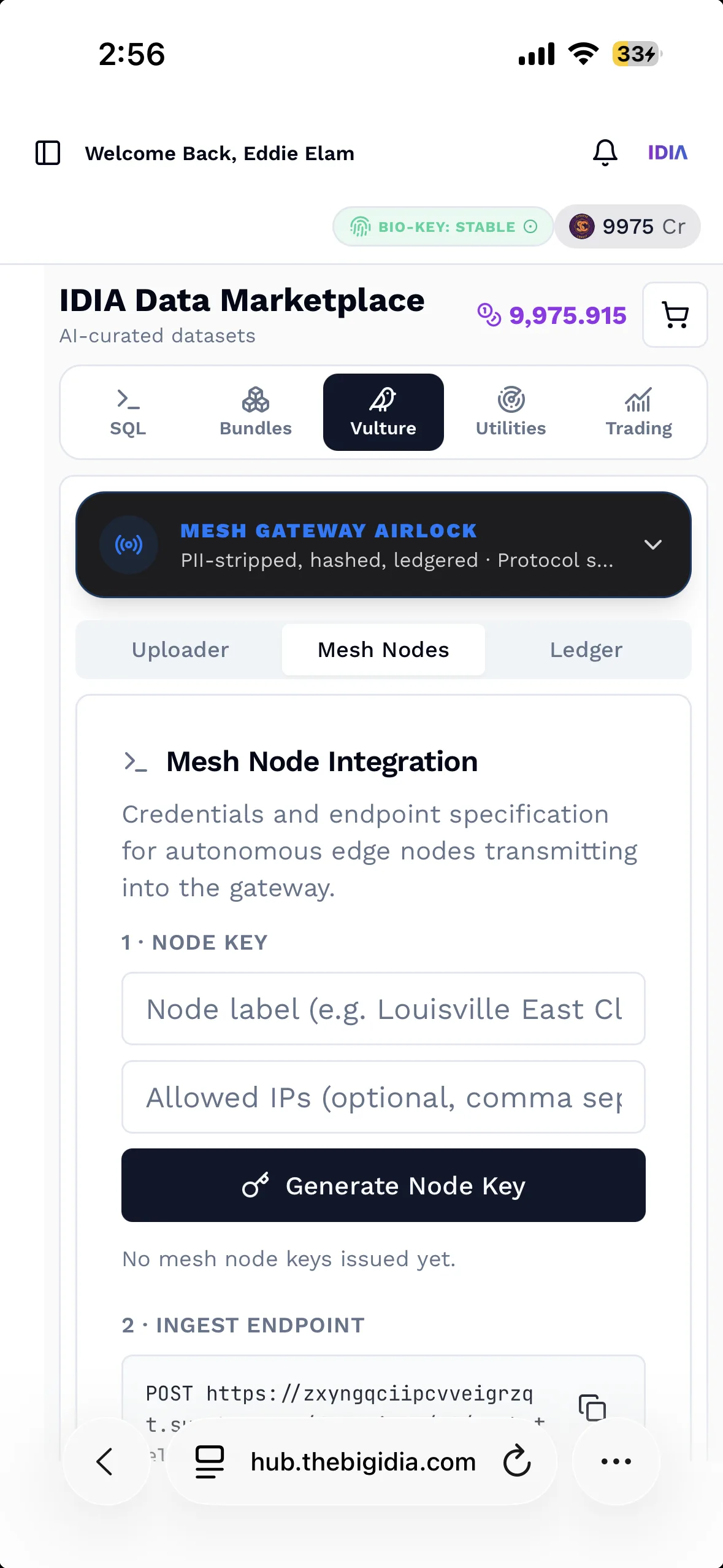
The IDIA Hub — Vulture · Mesh Node Integration. The Vulture tab in the Hub's Data Marketplace. The Mesh Gateway Airlock banner reads PII-stripped, hashed, ledgered. Partners label a node, optionally limit it to allowed IP addresses, generate a node key, then post to the ingest endpoint. Uploader and Ledger sit beside Mesh Nodes.

Real screenshotThe IDIA Hub

Vulture · Mesh Node Integration

The Vulture tab in the Hub's Data Marketplace. The Mesh Gateway Airlock banner reads PII-stripped, hashed, ledgered. Partners label a node, optionally limit it to allowed IP addresses, generate a node key, then post to the ingest endpoint. Uploader and Ledger sit beside Mesh Nodes.

Credit balance shown is from a team account.

Cost estimator · buyers

Traditional research cost vs paying per use on The IDIA Hub

Traditional costs come from published third-party research. IDIA costs use the real Synapse credit prices; how many queries a project needs is estimated, because there isn't enough buying history yet.

Project type

Project size

500 people · about 20 Hub queries a day (estimated)

1 week1 year

Illustrative comparison

Estimated cost over 3 months

Traditional · recruiting participants

$36,000 – $99,500

Source: Journal of Medical Internet Research, November 2020

The IDIA Hub · Synapse credits

$5,850 – $6,750

9,000 credits (estimated)

What you also get with each use

  • A receipt in Egress Logs
  • A Liability Receipt NFT on Base
  • Liability Shield coverage (capped)
  • Consent records you can check
  • No minimum contract — start from $2
How this is worked out
  1. Traditional: 500 people × $72–$199 per enrolled participant, paid once (price from cited research). Median recruitment cost per enrollee: $72 online, $199 offline. Recruitment only — devices, staff and data handling cost extra.
  2. IDIA: 20 queries a day × 5 credits each × 90 days = 9,000 credits (estimated).
  3. At $0.65–$0.75 a credit (real Hub prices; the lower rate is the volume tier this many credits reaches).
  • Illustrative comparison, not a quote or forecast. Real prices depend on sector, buyer weighting and record count.
  • Traditional costs vary widely by vendor and come from third-party research, not IDIA results.
  • IDIA streams are consented, de-identified data — not a like-for-like replacement for every clinical or regulated study. Raw data bundles are limited to buyers who pass T-1-P vetting.
  • Liability Shield coverage is capped at about $0.25 per credit used and is not insurance.

More in the Hub

  • Live now

    Synapse Credits

    Billing

    Prepaid credits that buyers use up on data requests and queries. Pay any amount from $2, or buy a volume tier, with USDC. Every deduction is recorded in a ledger.

  • Live now

    Earnings & settlement

    Billing

    An activity ledger, settlement records and contributor settlement hashes, so each payout can be traced back to the request it came from.

  • Live now

    Data viewer

    Data

    Search, filter and save views across the data streams you are allowed to see.

  • Live now

    Health data pipeline monitor

    Health

    Watch incoming health data, and recover failed batches, so problems with incoming data are visible.

  • Live now

    Compliance & API cleanroom

    Compliance

    A compliance dashboard and a controlled API space for checking data access. The Hub's intake ledger only accepts new entries and cannot be edited.

  • Live now

    Sovereign Vault

    Knowledge

    A private knowledge space for an organization's own documents and queries, also reachable from API endpoints and MCP connections.

The credits a buyer uses are what pay contributors: see how they become USDC and IDIA royalties in Life by IDIA.

See the full product journey